Don’t Fall into This Trap: Hogwarts Is Not Why Harry Potter Became a Best-Seller

If you were to ask yourself, Why was the Harry Potter series so record-smashingly popular?

It’d be easy to think, Well, Hogwarts, of course.

The Hogwarts setting is so imaginative, so detailed, so enthralling. In fact, that’s what Rowling herself used to think (“the magic is so fun and the idea of this hidden world is so appealing”). But then in 2011, she changed her mind.

She had gained some perspective, she said, after talking to thousands upon thousands of fans. The appeal of her story had nothing to do with setting at all. What was it? She realized that:

[readers had fallen] in love with the characters.

Character Trumps Setting

Some of the most popular novels recently have had memorable settings (e.g., The Hunger Games and Divergent), so it’s tempting to think that a unique setting is the be-all, end-all of a blockbuster book. It isn’t.

Only one thing can create a fresh, gripping story: character.

Or to be exact: character in conflict.

How to Create Characters in Conflict

Sample Study: This Side of Paradise by F. Scott Fitzgerald

Every year I reread The Great Gatsby, but this year I also read for the first time This Side of Paradise, which was Fitzgerald’s first published book.

One of Fitzgerald’s greatest talents as a writer was his ability to succinctly yet so clearly portray each of his characters’ inner and outer conflicts.

For example, here’s how he introduces the character Rosalind in This Side of Paradise.

Rosalind is—utterly Rosalind. She is one of those girls who need never make the slightest effort to have men fall in love with them. Two types of men seldom do: dull men are usually afraid of her cleverness and intellectual men are usually afraid of her beauty. All others are hers by natural prerogative.

If Rosalind could be spoiled the process would have been complete by this time, and as a matter of fact, her disposition is not all it should be; she wants what she wants when she wants it and she is prone to make every one around her pretty miserable when she doesn’t get it—but in the true sense she is not spoiled. Her fresh enthusiasm, her will to grow and learn, her endless faith in the inexhaustibility of romance, her courage and fundamental honesty—these things are not spoiled.

There are long periods when she cordially loathes her whole family. She is quite unprincipled; her philosophy is carpe diem for herself and laissez faire for others. She loves shocking stories: she has that coarse streak that usually goes with natures that are both fine and big. She wants people to like her, but if they do not it never worries her or changes her.

She is by no means a model character.

The education of all beautiful women is the knowledge of men. Rosalind has been disappointed in man after man as individuals, but she had great faith in man as a sex. Women she detested. They represented qualities that she felt and despised in herself—incipient meanness, conceit, cowardice, and petty dishonesty. She once told a roomful of her mother’s friends that the only excuse for women was the necessity for a disturbing element among men. She danced exceptionally well, drew cleverly but hastily, and had a startling facility with words, which she used only in love-letters.

The foreword to the 1996 edition of This Side of Paradise said that Fitzgerald was criticized for “the novel’s lack of polish, its dreadful spelling and frequent gaffs in word-choice.” These would ultimately prevent the book from reaching “the permanent heights of acclaim attained by his later works,” but still Paradise received “outstanding reviews and sold spectacularly.”

Why?

Because Fitzgerald built his story around interesting characters who were dealing with interesting conflicts.

Second Sample Study: The Great Gatsby by F. Scott Fitzgerald

The Great Gatsby is one of the most celebrated novels of all time—and it is all about characters in conflict.

Here’s how Fitzgerald introduces Tom Buchanan, a character who absolutely must be believable in order for readers to accept the story’s ending:

And so it happened that on a warm windy evening I drove over to East Egg to see two old friends whom I scarcely knew at all. Their house was even more elaborate than I expected, a cheerful red-and-white Georgian Colonial mansion, overlooking the bay. The lawn started at the beach and ran toward the front door for a quarter of a mile, jumping over sun-dials and brick walls and burning gardens—finally when it reached the house drifting up the side in bright vines as though from the momentum of its run. The front was broken by a line of French windows, glowing now with reflected gold and wide open to the warm windy afternoon, and Tom Buchanan in riding clothes was standing with his legs apart on the front porch.

He had changed since his New Haven [Yale] years. Now he was a sturdy straw-haired man of thirty with a rather hard mouth and a supercilious manner. Two shining arrogant eyes had established dominance over his face and gave him the appearance of always leaning aggressively forward. Not even the effeminate swank of his riding clothes could hide the enormous power of that body—he seemed to fill those glistening boots until he strained the top lacing, and you could see a great pack of muscle shifting when his shoulder moved under his thin coat. It was a body capable of enormous leverage—a cruel body.

Gatsby became a classic not because its setting of extreme wealth in the Jazz Age was interesting. It became a classic because Fitzgerald perfected the art of characters in conflict.

How to Create the Best Characters

One of Rowling’s greatest strengths as a writer is her ability to create complex, lifelike characters (Stephen King called her the current champ of backstory). I’ve included a chart below found on Tumblr which lists the different personality types of the Potter characterslook at all that conflict!

If you struggle with character development, I recommend Please Understand Me II by David Keirsey. It was my 2013 number one pick for best writing books. It’s actually a psychology book and it analyzes the sixteen types of personalities, covering everything from societal roles to parenting styles to sex lives.

Sign up for more valuable writing tips from a professional editor.

Harry Potter Myers-Briggs Chart

Story Structure in ‘Harry Potter and the Order of the Phoenix’

Since writing my series of posts on story structure for Harry Potter and the Sorcerer’s Stone, I’ve been asked numerous times to analyze another Potter book, particularly one of the longer, more complex ones. So I’ve picked the longest, beastliest book of the bunch: Harry Potter and the Order of the Phoenix.

(Of course my analysis will only be as helpful to you as your recollection of Phoenix, so feel free to skim through a summary of the plot for a refresher.)

This post will be a quick look at the specific plot points and pinch points in Phoenix—I won’t be repeating all the lengthy definitions and explanations of story structure from my first set of posts.

(If it’s been a while, you can reread my post, or you can simply buy Larry Brooks’ Story Engineering, which landed on my 2012 list of best writing books and is the bedrock of everything in this post.)

What Story Structure Looks Like

All right, let’s get down to it. Below is a graph of story structure in its most basic form:

Story Structure

Now here is a graph of the pinch points and plot points in Order of the Phoenix:

Story Structure Harry Potter and the Order of the Phoenix

How to Identify the Main Storyline

Rowling has several subplots in Phoenix. To name only a few:

  • Harry’s romance with Cho;
  • Harry’s Occlumency lessons with Snape;
  • and Harry’s ongoing feud with Dolores Umbridge.

These subplots, however, still tie in to and enhance the main plot, which is:

Voldemort’s attempts to acquire a secret weapon and Harry’s attempts to stop him.

[Note: It’s important to know as the writer exactly what your main plot is, because your main plot determines what your story’s pinch points will be.]

What You Need for the First Plot Point

Remember that the first plot point has to fulfill two criteria:

1) The hero needs to get his marching orders.

2) He needs to set out on a journey (otherwise known as “the point of no return”).

No one wants to read about a hero who has a mission but nowhere to go, or vice versa, a hero who’s going somewhere but has no mission.

Harry gets his “marching orders” in Phoenix when Sirius tells him that Voldemort is trying to acquire a weapon; soon after Harry sets out on his journey to Hogwarts.

Understanding Anomalies in Story Structure

In both Phoenix and Sorcerer’s Stone, the placement of Part Four of story structure—The Resolution—falls short of the expected 20-percent mark.

This variance is typical in books that rely heavily on uncovering a mystery (in these two cases, a stone and a weapon). Once that mystery is revealed it’s a mad rush to the finish, thus the shorter ending.

What Rowling Did Wrong: On Respecting the Rights of Readers

Last month J. K. Rowling started a hullabaloo when she questioned the suitability and long-term viability of Ron and Hermione’s relationship.

I personally wasn’t fazed by the whole who-should-be-with-who argument. What did concern me was that Rowling had overstepped her bounds as an author by casting doubt on a storyline she had already finished. 

The Harry Potter series had (and still has) a huge impact on the literary world, which means that Rowling has a huge impact on the literary world. She is currently the most well-known example of what it means to be a writer—and that’s why her comment irks me. It disrespects the relationship between writer and reader.

I know some of you disagree with me. You say that Rowling clearly identifies with Hermione and is more musing on her own life than on the lives of her characters. But here’s the thing:

You’re absolutely right.

The Potter characters obviously mean a great deal to Rowling. In a 2012 interview with Oprah, she said:

When [Harry Potter] ended, I was in a slight state of shock. Initially I was elated, but then there came a point [when] I cried as I’ve only cried once before in my life and that was when my mother died. It was uncontrollable . . . For 17 years I’d had [these books], through some very tumultuous times in my personal life, and I’d always had that. It was an escape for all these children; you can imagine what it had been for me.

And when Oprah said, “But you know what happens ever after,” Rowling replied:

Yeah, I do. I couldn’t stop. I don’t think you can stop when you’ve been that involved with characters for that long. It’s still all in there. They’re all in my head still. I mean, I could definitely write an eighth, ninth, tenth [book].

Let me clarify.

I’m not saying that Rowling doesn’t have the right to portray her characters as she sees fit or that she doesn’t have the right to vicariously portray herself through her characters. I would’ve had no problem with Rowling’s Ron/Hermione comment if she had written those ideas in an eighth, ninth, or tenth book.

But once a writer puts down her pen, she’s handed over the imaginative rights of her story to her readers, and it’s disrespectful to take that back and say, No, this is actually what happens, no matter how you imagined it.

Just after finishing the final Potter book, Rowling said:

It gives me a certain satisfaction to say what I thought happened and to tell other people that, because I would like my version to be the official version still even though I haven’t written it in a book. Because it’s my world.

Part of me agrees with her. She did spend years writing Harry Potter and it is her world . . . but then there’s another part of me that says, Isn’t that selfish, though?

Rowling insists she’s done with Potter, yet she won’t allow her readers to keep the story alive in their own imaginations and in their own ways.

In the end this argument boils down to one simple question: where does a writer draw the line between her rights as creator and her responsibility to readers?

I firmly believe that the best books come from writers who have the utmost respect for their readers; they’re driven to create better stories, better characters, and better worlds because they have too much respect for their readers to give anything less.

And yes, Rowling has done that in so many ways . . . I just have to disagree with her on this one.

Sign up now for more tips from a professional editor.

Letting Go after Publishing: Why Rowling Shouldn’t Have Commented on Ron and Hermione’s Relationship

Have you heard the latest buzz in the Muggle world?

Hermione-actress Emma Watson interviewed J. K. Rowling for the British entertainment mag Wonderland and some of Rowling’s quotes have made quite a stir.

The magazine itself doesn’t hit newsstands until next week, but snippets of the interview have leaked, wherein Rowling claims she made a mistake pairing Hermione with Ron instead of Harry:

I wrote the Hermione/Ron relationship as a form of wish fulfillment. That’s how it was conceived, really. For reasons that have very little to do with literature and far more to do with me clinging to the plot as I first imagined it, Hermione ended up with Ron.

She goes on to say:

I know, I’m sorry. I can hear the rage and fury it might cause some fans, but if I’m absolutely honest, distance has given me perspective on that. It was a choice I made for very personal reasons, not for reasons of credibility. Am I breaking people’s hearts by saying this? I hope not.

She also adds that Hermione and Ron will probably end up in couple’s therapy.

Not surprisingly, Potter fans have taken sides on the issue. Personally, I’m for leaving Hermione and Ron alone, and here’s why:

Rowling finished writing the books.

That’s it. That’s my only reason.

A writer will always have the itch to go back and change things. Words are permanent and you want everything to be perfect, I get that, but I’m coming from a reader’s perspective.

Any time a writer tries to dial back the clock and correct or clarify something that’s already been published, she pulls apart her intricately woven story and exposes all the ugly wires underneath. She reminds her readers that it was “only a story.” Not real people in a real world trying to solve real problems but just some characters slapped on a page.

To write an enthralling story is to create an illusion—a magic trick—and every time Rowling steps in and says, Oh wait, I should’ve done this instead, the illusion is spoiled.

Furthermore, by questioning Ron and Hermione’s relationship, Rowling violated the rights of her readers. Check out my next post for more on that.

Sign up now for more tips from a professional editor.

Top 5 Best Books on Writing in 2013

#5

Thanks, But This Isn’t for Us: A (Sort Of) Compassionate Guide to Why Your Writing is Being Rejected by Jessica Page Morrell

While this book seems to have gotten buried under the mounds of other writing books out there, it’s still a gem. Morrell’s advice is spot-on and—bonus points—she’s funny. I gobbled up the nearly four hundred pages in a matter of days.

#4

The Writer’s Book of Hope: Getting from Frustration to Publication by Ralph Keyes

Keyes’ first writing book, The Courage to Write: How Writers Transcend Fear, is more popular than this one. I’ve read both and my advice is to read one or the other; they pretty much cover the same concepts. But I would definitely recommend reading one of them, especially after the beating you’ll get from Morrell in Thanks, But This Isn’t for Us.

#3

Write Every Day: How to Writer Faster, and Write More by Cathy Yardley

I read this little e-book in one sitting (I love that Yardley doesn’t pad her writing books with unnecessary fluff). Write Every Day is the writer’s version of an awesome pep talk before the big game.

#2

Blueprint Your Bestseller: Organize and Revise Any Manuscript with the Book Architecture Method by Stuart Horwitz

This one is an obvious winner given that I have written four lengthy posts on how the methods in this book helped Rowling create complex plots and deep characters for her Harry Potter series. If you haven’t read my posts yet, here’s the first of four.

And now for my number one writing book in 2013 (although it’s not technically a writing book):

#1

Please Understand Me II: Temperament, Character, Intelligence by David Keirsey

This is a psychology textbook that was originally published back in the late ’70s, then revamped in 1998. Keirsey begins his book with a quote from Henry David Thoreau:

If a man does not keep pace with his companions, perhaps it is because he hears a different drummer. Let him step to the music which he hears, however measured or far away.

I chose this book as my number one pick because you cannot write incredible, believable fiction (or nonfiction, for that matter) if you do not have a deep understanding of people.

In three hundred fascinating pages, Keirsey delves into everything you can imagine about the sixteen different personality types: their interests, values, self-image, social roles, word usage, mating and parenting styles, even their sexual inclinations. He somehow manages to be both sweepingly broad yet painstakingly detailed.

One of Rowling’s particular strengths as a writer is her ability to depict so many different types of people in a very believable way. Her Harry Potter characters go deeper than looks and mannerisms; she gave them complex wants, needs, motives, and temperaments.

So if you’re looking to step up your writing game, check out Please Understand Me II.

(And if you missed last year’s list of best writing books, click here.)

Sign up now for more tips from a professional editor.

How Rowling Developed Suspense, Surprise, and Shock (Rowling’s Outline and the Book Architecture Method, Pt IV)

This is it! The last post on Rowling’s outlining process and how she used series to develop her complex plots.

Here’s a quick recap of what we’ve talked about so far based on Stuart Horwitz’s Blueprint Your Besteller:

  1. A series is the repetition of any narrative element within a story (like a person, an object, or even a place or phrase). Some examples of series from Harry Potter and the Order of the Phoenix include: The Hall of Prophecy; Harry’s feelings for Cho and Ginny; Dumbledore’s Army; the Order of the Phoenix; Harry’s Occlumency lessons with Snape; and the mystery of Hagrid’s half-brother, Grawp.
  2. For a series to be worth keeping in a story it needs to a) repeat but vary, forming the undulating effect of a narrative arc, and b) intersect and interact with the other series in the story in such a way that it sends the story spinning in new directions.
  3. The strength of a novel is determined by the strength of its key scenes. A key scene is when multiple series come together and play off one another. Key scenes tie together all the loose story threads to create a tight-knit novel. An example of a key scene in Rowling’s outline is the scene following Harry’s dream about Mr. Weasley being attacked by Voldemort’s snake, Nagini. The scene deals with four of the six series listed above: The Hall of Prophecy; Ginny; Dumbledore’s Army; and the Order of the Phoenix.

How to Create Suspense, Surprise, and Shock

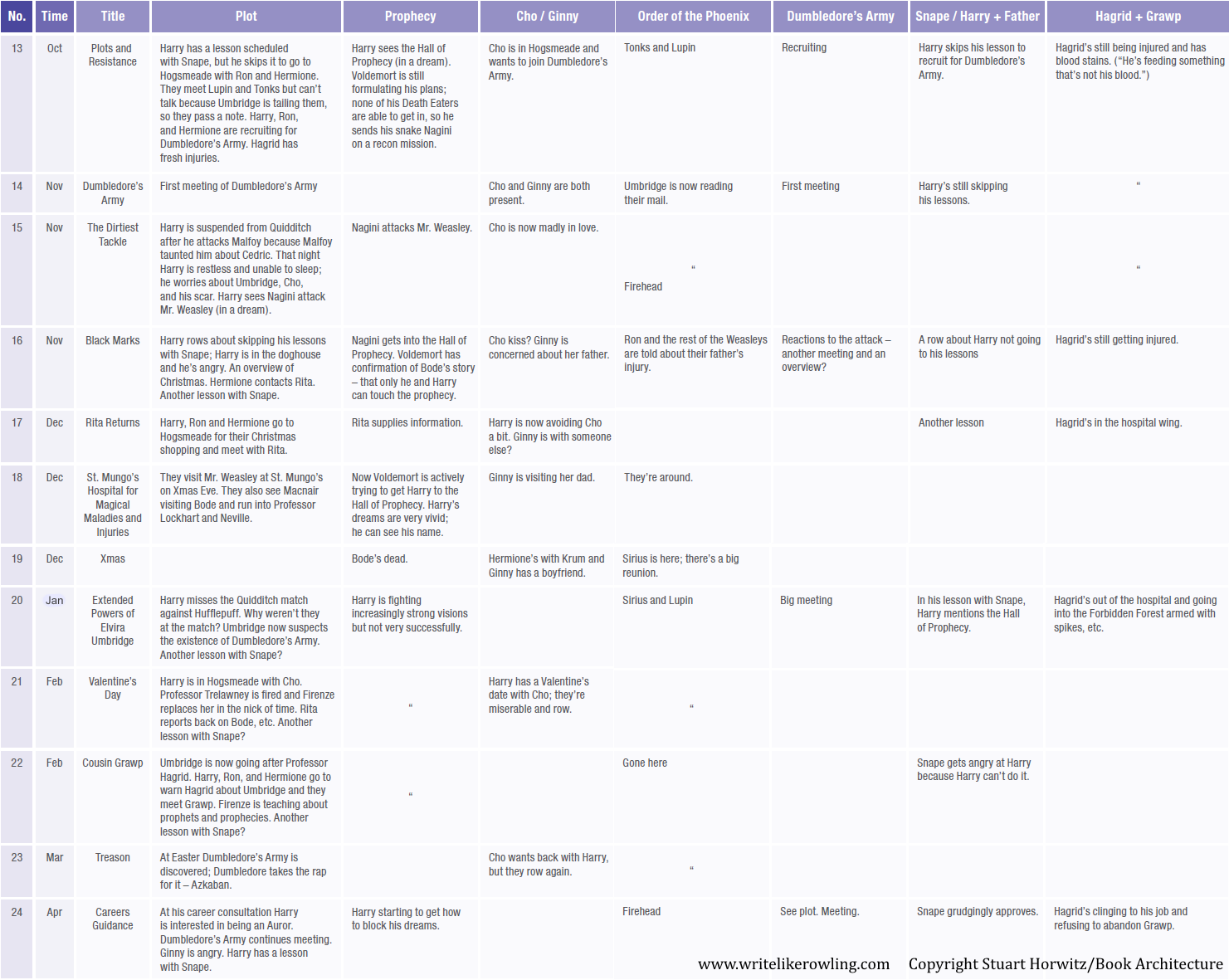
When Rowling outlined Order of the Phoenix, she was able to keep track of her complicated plot by dividing it into columns on paper based on which series a storyline belonged to and jotting down the development of each series in each chapter. And it’s because Rowling took the time to break down her plot into individual series that she was able to precisely place throughout her story the important elements of suspense, surprise, and shock.

Readers love books that have suspense, surprise, and shock. In fact, a book that doesn’t have those three S’s probably won’t get far off the shelf (or out of the desk drawer).

Unfortunately, a book that’s lacking suspense, surprise, or shock is not easily fixed. You cannot just toss a random bar brawl into a story and expect it to surprise or shock a reader. The hardest part about including the three S’s is figuring out how to organically grow them from the roots of your story, and that’s what Rowling is so good at in her Potter books.

Everything in Rowling’s intricately developed seven-book-long plot has meaning and purpose—from the very beginning in Sorcerer’s Stone when Hagrid uses Sirius’ motorcycle to drop off Harry at the Dursley’s front door all the way to the end in Deathly Hallows when Snape reveals the significance of his patronus. Rowling had to keep track of every one of those details throughout the 4,195 pages of her story.

But before she could even get that far, she had to first figure out how to get her readers to want to read 4,195 pages.

How to Track Your Plot’s Development

By dividing her story into series and then noting the development of each series in its own column, Rowling was able to pinpoint when, where, and how she would surprise or shock her readers, or continue leaving them in suspense.

Look at this bit of outline she wrote for Harry Potter and the Order of the Phoenix:

Transcribed Rowling Outline

Creating Suspense

Let’s start with suspense. In Blueprint Your Bestseller Horwitz explains how to create suspense in a series:

The effect of suspense is achieved when we are continually told what we don’t know . . . The iterations [of a series] are closer together and they are well managed to produce the effect that something is imminently going to be communicated to us.

An example of suspense would be the “Hagrid + Grawp” series. Rowling obviously changes things between this outline and the final draft, but still, she plans from the beginning to continually remind us of Hagrid’s injuries without telling us where he’s getting the injuries from. She continues to build the suspense by mentioning his injuries getting bloodier and more frequent, until nearly the end of the book when she relieves the suspense by revealing the secret behind his injuries in Chapter 30, aptly titled “Grawp.”

That’s suspense. Now for surprise.

Creating Surprise

Here’s Horwitz on how to surprise readers:

When the gaps between iterations are longer, surprise occurs . . . When an individual series suddenly returns to our conscious mind after such a pause and we experience the next iteration as unique yet familiar, this is surprise.

For example, at the end of Order of the Phoenix, Dumbledore reveals to Harry that the person who prophesied that Harry would be Voldemort’s equal is the highly unlikely Professor Trelawney. Trelawney is an extremely un-gifted Seer and has only given a real prophecy once before, back in book three, Harry Potter and the Prisoner of Azkaban. Rowling hadn’t mentioned Trelawney’s sporadic prophesying for quite some time, so the effect is surprise.

Creating Shock

And lastly, how to shock readers:

Shock occurs when there is barely one iteration before a disclosure takes place. With shock there needs to be something that would have admitted this possibility—the iteration that delivers a shock seems to come out of nowhere while not being totally unexpected in hindsight.

Rowling uses shock quite a bit in her Potter series—a difficult thing to pull off because readers don’t like to be tricked (they liked to be shocked but not tricked).

For shock to work, a writer has to give her readers all the hints they’d need to figure it out themselves, and then the writer has to somehow unexpectedly twist things around at the end.

An example of shock in Order of the Phoenix is the death of Sirius Black. It seems to come out of nowhere, but Rowling slyly set things up so that, in hindsight, it’s not completely unexpected.

For instance, Rowling clearly establishes that Sirius is hot-headed, impulsive, and very unhappy staying hidden at home instead of working alongside the rest of the Order. On top of that, Sirius is extremely loyal to Harry and would stop at nothing to protect him, which is ultimately what leads him to his death. All these things, however, are relatively minor character details that are easy to skim over in Rowling’s 870-page book, so when Sirius dies, the effect is shock. But the reader does not feel cheated because Rowling includes enough of those minor details so that it all adds up in the end.

And there you have it! It’s ultimately because Rowling understood how to organically integrate suspense, surprise, and shock into her plot that she was able to create a new and exciting story for each of her seven books. 

And that brings us to the end of this series of posts (get it, series?). I’m excited for my next few, especially my post on the best writing books I read this year.

Sign up now for more tips from a professional editor.

Looking for more posts on the Book Architecture Method? Check out these:

How Rowling Turned a Story Idea into a Best-Selling Series (Rowling’s Outline and the Book Architecture Method, Pt I)

How Rowling Formed Her Narrative Arc (Rowling’s Outline and the Book Architecture Method, Pt II)

How Rowling Created Key Scenes (Rowling’s Outline and the Book Architecture Method, Pt III)

How Rowling Created Key Scenes (Rowling’s Outline and the Book Architecture Method, Pt III)

Remember that a series is the repetition of any narrative element within a story (like a person, an object, or even a place or phrase). Here are some of the series Rowling outlined for Harry Potter and the Order of the Phoenix: The Hall of Prophecy; Harry’s feelings for Cho and Ginny; organizing Dumbledore’s Army and the Order of the Phoenix; Harry’s Occlumency lessons with Snape, and the mystery of Hagrid’s half-brother, Grawp. Notice in Rowling’s outline that each series has its own column, and for each chapter she jots down how each series is developing. She also has a column that’s simply labeled “plot” where she keeps track of which series is stepping into the spotlight when.

Transcribed Rowling Outline

I ended my last post on series with a question: How did Rowling know that each of the six series she listed was worth keeping?

A series worth keeping not only evolves in its own right but also has the power to change the direction of the entire story. In Rowling’s outline, all of her series intersect and interact with each other in such a way that if one were taken out, the story would be off-kilter. The individual scenes in her “plot” column illustrate especially well how her different series come together and play off one another. And that is the definition of a key scene: When several series collide and send the story spinning in new directions.

Not having these very important interactions between series in a key scene is what readers are describing when they say a book is “slow” or “nothing happens.” Here’s what Stuart Horwitz has to say about it in Blueprint your Bestseller:

When series interact, anything can happen. They can conflict and send one another spinning. One series can slow another down or stop it all together . . . [But] if you don’t have key scenes, if your series don’t intersect that often, you may have found the root of the problem with your manuscript. This often comes about in the middle of the narrative, where the length of time a reader has invested in your work is not being repaid – the payoff lies in being able to make the connections that key scenes produce when series intersect.

All scenes should be good scenes, but not all good scenes are key scenes. So how to differentiate between a good scene and a key scene? Here’s Horwitz again:

A good scene may be an important scene, a memorable scene, but it is not necessarily a key scene unless it contains the maximum interaction of series.

Where is a good scene and where is a key scene in Rowling’s outline?

The “Hagrid + Grawp” column is full of examples of good scenes. Rowling obviously changed a number of things between the time when she wrote this outline and when she finished writing the book, but you can still see that many of her good scenes for the “Hagrid +Grawp” series made it into the final cut. For example, Chapter 30 is titled “Grawp” and that’s what the majority of the chapter is about: It focuses on the “Hagrid + Grawp” series with pretty much no interaction with any of the other series. That’s a good scene, but it’s not a key scene.

Now take a look at the scene that deals with the aftermath of Harry dreaming about Mr. Weasley being bitten by a snake. It starts in Chapter 22, “St. Mungo’s Hospital for Magical Maladies and Injuries.” In this scene, we’re dealing with multiple series interacting with each other: the Hall of Prophecy (because that’s where Mr. Weasley was attacked); Ginny (because Harry watches her reaction when she’s told about her father’s injuries); Dumbledore’s Army (because the Weasley kids make up a sizable chunk of the D.A.), and the Order of the Phoenix (because Mr. Weasley was injured while standing guard for the Order). That’s already four of the six series on Rowling’s outline. It’s a key scene.

(I’d also like to point out that this scene is the midpoint of the story. This is when everything changes. Until then, Harry’s dreams appear to be just dreams, but this dream is real. Mr. Weasley’s attack is the catalyst that forces Harry to become a warrior and start taking action. Plot points, such as the midpoint, usually involve the collision of multiple series because that’s when everything starts coming together. For more on story structure, click here.)

One of Rowling’s biggest strengths as a writer is that she is so adept at tightly intertwining her series so that everything in the story feels like it has a purpose (even if we don’t know why at first).

Stay tuned for the next post where we’ll discuss how to determine your main series and how you can use series to create suspense, surprise and shock.

More posts on The Book Architecture Method: 

How Rowling Turned a Story Idea into a Best-Selling Series (Rowling’s Outline and the Book Architecture Method, Pt I)

How Rowling Formed Her Narrative Arc (Rowling’s Outline and the Book Architecture Method, Pt II)

How Rowling Developed Suspense, Surprise, and Shock (Rowling’s Outline and the Book Architecture Method, Pt IV)

*Photo by Gabrielle Courchesne Delisle @ 500px / CC BY-ND

Make Your Writing Quirks Work for You


Anne Rice
“I’ve been told all my life that I was not a writer! I just marvel at it.”

Best-selling writer Anne Rice was the featured interviewee in the Nov/Dec ’13 edition of Writer’s Digest. It was so refreshing to hear Anne stress that there are no rules in writing. In fact, she’s been frequently told that she isn’t a “real writer”:

I was discouraged very early in my college years by people who told me I wasn’t a real writer because I didn’t write every day. Things like that should not be said. And anybody who says anything like that, you have to ignore them. You know, there are no rules.

And I love how she openly shares her struggles with certain parts of the writing process:

The biggest problem for me . . . is getting into the story. I can see the whole thing. The whole shape, all the characters, what they’re doing, and I can’t seem to find a way to break in. And I rewrite the opening pages over and over and over again. It’s like OCD—it’s like hand-washing. And finally I get so frustrated that I go and pick up something like The Godfather by Mario Puzo, which is great storytelling, but just any way he wants to do it. I mean, he may introduce Luca Brasi here, and never get to physically describing him until 50 pages later, to never get to telling who he really is until 100 pages after that. And that clears up my OCD. OK, just plunge—just start. Just go.

(She also added that it isn’t until she’s two or three hundred pages into a manuscript when she finally knows she’s not going to quit!)

I especially like Anne’s parting thoughts at the end of the interview:

Protect your voice and your vision . . . Do what gets you to write, and not what blocks you. And no matter where you are in your career, whether you’re published, unpublished, or just starting out, walk through the world as a writer. That’s who you are, and that’s what you want to be, and don’t take any guff off anybody.