How Rowling Created Key Scenes (Rowling’s Outline and the Book Architecture Method, Pt III)

Remember that a series is the repetition of any narrative element within a story (like a person, an object, or even a place or phrase). Here are some of the series Rowling outlined for Harry Potter and the Order of the Phoenix: The Hall of Prophecy; Harry’s feelings for Cho and Ginny; organizing Dumbledore’s Army and the Order of the Phoenix; Harry’s Occlumency lessons with Snape, and the mystery of Hagrid’s half-brother, Grawp. Notice in Rowling’s outline that each series has its own column, and for each chapter she jots down how each series is developing. She also has a column that’s simply labeled “plot” where she keeps track of which series is stepping into the spotlight when.
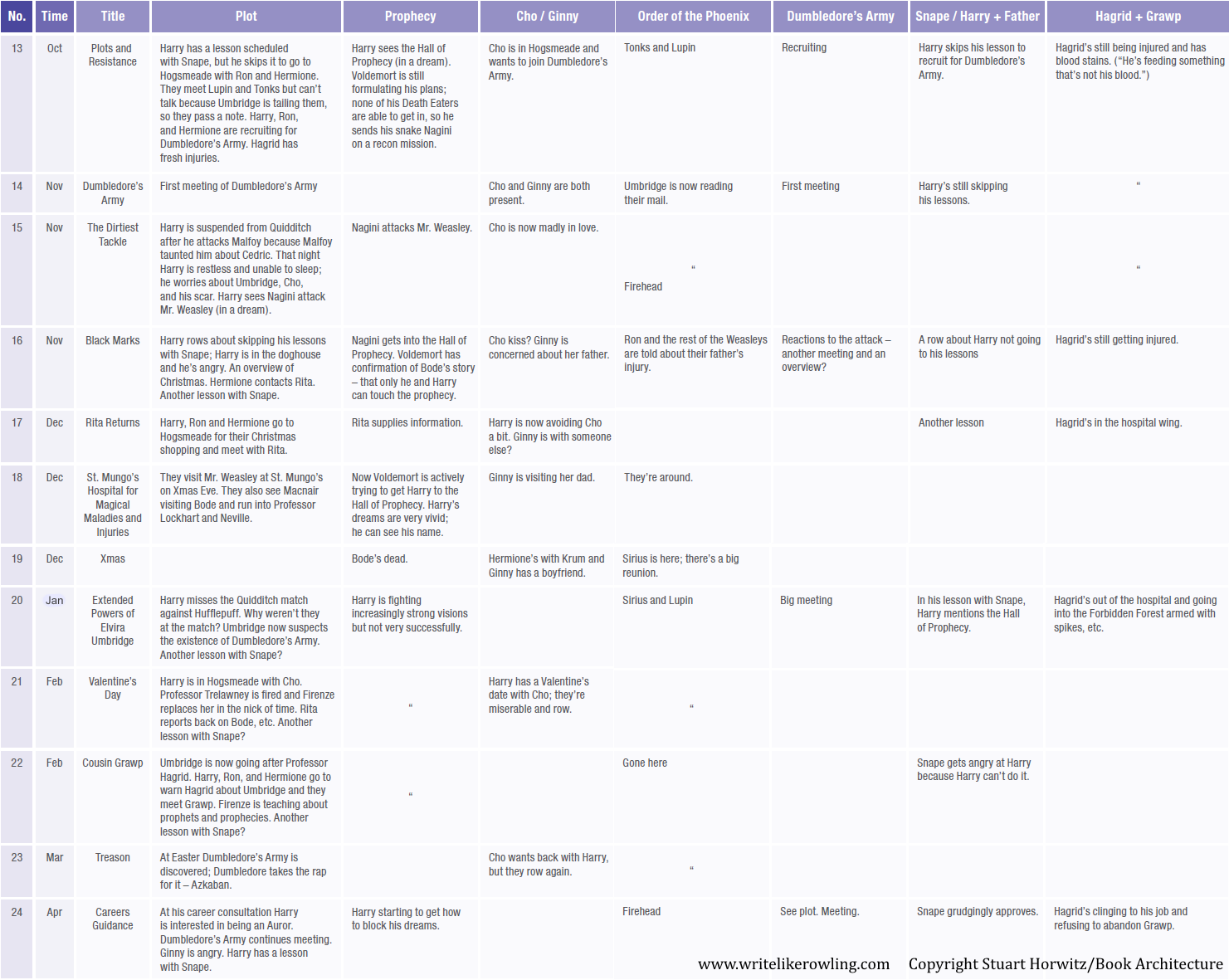
Transcribed Rowling Outline

I ended my last post on series with a question: How did Rowling know that each of the six series she listed was worth keeping?

A series worth keeping not only evolves in its own right but also has the power to change the direction of the entire story. In Rowling’s outline, all of her series intersect and interact with each other in such a way that if one were taken out, the story would be off-kilter. The individual scenes in her “plot” column illustrate especially well how her different series come together and play off one another. And that is the definition of a key scene: When several series collide and send the story spinning in new directions.

Not having these very important interactions between series in a key scene is what readers are describing when they say a book is “slow” or “nothing happens.” Here’s what Stuart Horwitz has to say about it in Blueprint your Bestseller:

When series interact, anything can happen. They can conflict and send one another spinning. One series can slow another down or stop it all together . . . [But] if you don’t have key scenes, if your series don’t intersect that often, you may have found the root of the problem with your manuscript. This often comes about in the middle of the narrative, where the length of time a reader has invested in your work is not being repaid – the payoff lies in being able to make the connections that key scenes produce when series intersect.

All scenes should be good scenes, but not all good scenes are key scenes. So how to differentiate between a good scene and a key scene? Here’s Horwitz again:

A good scene may be an important scene, a memorable scene, but it is not necessarily a key scene unless it contains the maximum interaction of series.

Where is a good scene and where is a key scene in Rowling’s outline?

The “Hagrid + Grawp” column is full of examples of good scenes. Rowling obviously changed a number of things between the time when she wrote this outline and when she finished writing the book, but you can still see that many of her good scenes for the “Hagrid +Grawp” series made it into the final cut. For example, Chapter 30 is titled “Grawp” and that’s what the majority of the chapter is about: It focuses on the “Hagrid + Grawp” series with pretty much no interaction with any of the other series. That’s a good scene, but it’s not a key scene.

Now take a look at the scene that deals with the aftermath of Harry dreaming about Mr. Weasley being bitten by a snake. It starts in Chapter 22, “St. Mungo’s Hospital for Magical Maladies and Injuries.” In this scene, we’re dealing with multiple series interacting with each other: the Hall of Prophecy (because that’s where Mr. Weasley was attacked); Ginny (because Harry watches her reaction when she’s told about her father’s injuries); Dumbledore’s Army (because the Weasley kids make up a sizable chunk of the D.A.), and the Order of the Phoenix (because Mr. Weasley was injured while standing guard for the Order). That’s already four of the six series on Rowling’s outline. It’s a key scene.

(I’d also like to point out that this scene is the midpoint of the story. This is when everything changes. Until then, Harry’s dreams appear to be just dreams, but this dream is real. Mr. Weasley’s attack is the catalyst that forces Harry to become a warrior and start taking action. Plot points, such as the midpoint, usually involve the collision of multiple series because that’s when everything starts coming together. For more on story structure, click here.)

One of Rowling’s biggest strengths as a writer is that she is so adept at tightly intertwining her series so that everything in the story feels like it has a purpose (even if we don’t know why at first).

Stay tuned for the next post where we’ll discuss how to determine your main series and how you can use series to create suspense, surprise and shock.

More posts on The Book Architecture Method: 

How Rowling Turned a Story Idea into a Best-Selling Series (Rowling’s Outline and the Book Architecture Method, Pt I)

How Rowling Formed Her Narrative Arc (Rowling’s Outline and the Book Architecture Method, Pt II)

How Rowling Developed Suspense, Surprise, and Shock (Rowling’s Outline and the Book Architecture Method, Pt IV)

*Photo by Gabrielle Courchesne Delisle @ 500px / CC BY-ND

Make Your Writing Quirks Work for You


Anne Rice
“I’ve been told all my life that I was not a writer! I just marvel at it.”

Best-selling writer Anne Rice was the featured interviewee in the Nov/Dec ’13 edition of Writer’s Digest. It was so refreshing to hear Anne stress that there are no rules in writing. In fact, she’s been frequently told that she isn’t a “real writer”:

I was discouraged very early in my college years by people who told me I wasn’t a real writer because I didn’t write every day. Things like that should not be said. And anybody who says anything like that, you have to ignore them. You know, there are no rules.

And I love how she openly shares her struggles with certain parts of the writing process:

The biggest problem for me . . . is getting into the story. I can see the whole thing. The whole shape, all the characters, what they’re doing, and I can’t seem to find a way to break in. And I rewrite the opening pages over and over and over again. It’s like OCD—it’s like hand-washing. And finally I get so frustrated that I go and pick up something like The Godfather by Mario Puzo, which is great storytelling, but just any way he wants to do it. I mean, he may introduce Luca Brasi here, and never get to physically describing him until 50 pages later, to never get to telling who he really is until 100 pages after that. And that clears up my OCD. OK, just plunge—just start. Just go.

(She also added that it isn’t until she’s two or three hundred pages into a manuscript when she finally knows she’s not going to quit!)

I especially like Anne’s parting thoughts at the end of the interview:

Protect your voice and your vision . . . Do what gets you to write, and not what blocks you. And no matter where you are in your career, whether you’re published, unpublished, or just starting out, walk through the world as a writer. That’s who you are, and that’s what you want to be, and don’t take any guff off anybody.

How Rowling Formed Her Narrative Arc (Rowling’s Outline and the Book Architecture Method, Pt II)

In my previous post we looked at how Rowling was able to build her complex plot by, ironically, breaking it down into individual series that collide and interact in significant ways.

The different series Rowling outlined include: The Hall of Prophecy; Harry’s feelings for Cho and Ginny; the creation of Dumbledore’s Army and the Order of the Phoenix; Harry’s relationship with Snape, and the mystery of Hagrid’s half-brother, Grawp.

For a quick recap on the definition of a series, here’s Stuart Horwitz in his book Blueprint Your Bestseller:

[A series is] the repetition of a narrative element (such as a person, an object, a phrase, or a place) in such a way that it undergoes a clear evolution.

How did Rowling know that each of the six subjects she included in her outline was substantial enough to be its own series? As most writers wrestling with book-length manuscripts know, there’s a fine line between an idea that can add depth to a story and one that will just drag it down. How is a writer to know the difference? Here’s Horwitz again:

A series worth keeping track of needs to enter the action at some point.

For a story element to have the potential to become a full-fledged series, it must fulfill two criteria: One, the series needs to repeat and vary throughout the story. Horwitz calls each repetition in a series an iteration. He chose not to use other possible synonyms such as occurrence or example (which, in my opinion, would be less wordy and confusing) because of the relationship between the word iterate and the word reiterate.

To reiterate something is to repeat it, any number of times, for emphasis. Nothing is ever the same the second time, however; even if the iteration is repeated exactly, the context has changed. Instead, repetition gives birth to variation – and the interplay between repetition and variation forms the core of the concept of series.

Check out how Rowling handled it in her outline:

Transcribed Rowling Outline

Each series Rowling lists has numerous repetitions and variations. For example, in the “Hagrid + Grawp” series, she has Hagrid sporting injuries numerous times (for reasons unknown to both Harry and the reader), and then she varies that series by revealing the reason for his injuries and tops it off by throwing in the possibility of Hagrid losing his job. Rowling was only developing these ideas in her outline, but she obviously understood the premise that a series needs to both repeat and vary in order to “create a rich experience for the reader, one that is satisfying yet unexpected.”

These repetitions and variations create an undulating effect in the overall story, moving up in improvement or down in deterioration – and that is what forms the narrative arc.

Before we move on to the second criteria for a series, a quick warning from Horwitz on using repetition and variation:

Repetition can get dangerously close to boring. You have to be careful when you have the same event or adjective or discussion happening over and over again. [On the other hand], you can’t have all variation, either. . . it is the pattern created by repetition and variation that communicates meaning.

You need to have repetition, but not too much or you’ll lose your reader – and you need to have variation but not too much or you’ll confuse your reader. Kind of frustrating, right? It’s definitely a balancing act. Writing will always be more of an art than a science.

Now on to the second criteria for a series: A series also needs to intersect and interact with the other series in the story in such a way that the series sends the story spinning in new directions. This intentional collision of series is what reviewers are typically describing when they say a book is “riveting” or its plot is “airtight.”

These occasions, when series come together in a proximate, physical, literal sense, give a reader the feeling that “it is all coming together.”

And that feeling of “it’s all coming together” is what keeps readers reading. How did Rowling get to that level in her books? Stay tuned for that in the next post along with a discussion on how to pick out your main series from the rest and how to identify your key scenes.

For more posts on The Book Architecture Method:

How Rowling Turned a Story Idea into a Best-Selling Series (Rowling’s Outline and the Book Architecture Method, Pt I)

How Rowling Created Key Scenes (Rowling’s Outline and the Book Architecture Method, Pt III)

How Rowling Developed Suspense, Surprise, and Shock (Rowling’s Outline and the Book Architecture Method, Pt IV)

How Rowling Turned a Story Idea into a Best-Selling Series (Rowling’s Outline and the Book Architecture Method, Pt I)

If there’s nothing us writers like more than reading a great book, it’s seeing how that book came to be. Lucky for us, we got exactly that when Rowling released a snippet of her outline for the fifth Potter book, Harry Potter and the Order of the Phoenix.

Problems with Order of the Phoenix

First, let me say that Book Five is my least favorite of the bunch. It’s an 870-page beast with a number of redundant scenes (like when Harry is either dreaming or arguing). Even Rowling wishes it had been better edited.

Still, the book deserves praise, especially considering its intricate plot and the abundance of characters (and all written on a tight deadline). Stephen King said he liked the fifth book “quite a bit better” than the previous four, and added,”Harry will take his place with Alice, Huck, Frodo, and Dorothy, and this is one series not just for the decade, but for the ages.”

In recent posts, we saw how Rowling’s plot for the Sorcerer’s Stone hit all of the structural milestones necessary for a tight-knit novel. But now the question is, how exactly did Rowling develop her story idea into seven weighty books?

For this post, I’ll be drawing solely from Stuart Horwitz’s groundbreaking book, Blueprint Your Bestseller: Organize and Revise Any Manuscript with the Book Architecture Method.

Don’t Say “Plot”

Ironically, I frequently used the word plot in my last post, but now plot is a four-letter word. Horwitz explains why he dislikes the word so much, and I have to say, I agree with him.

For one thing, [plot] is a term with nearly unlimited associations. It’s hard to get anybody to focus on what is actually going on in their book while they are worried about whether their plot is good. For another thing, plot is singular, as if it somehow references everything. As such, you can’t work with a plot.

Rowling obviously agrees with Horwitz, because look at how she structures her outline for Order of the Phoenix. (You can enlarge my transcription below by clicking on it. I cleaned up the outline by writing out abbreviations and completing sentences.)

Rowling Outline

Transcribed Rowling Outline

Series: The Real Plot

Series is what Horwitz says should replace plot (and sorry, the plural of series is series). Although Rowling uses the word plot, notice her outline isn’t simply one chaotic column that’s trying to track everything. Instead, she divides the action into six columns of individual series:

1. The Hall of Prophecy
2. Harry’s feelings for Cho versus Ginny
3. The creation of Dumbledore’s Army
4. The creation of Order of the Phoenix
5. Harry’s relationship with Snape
6. And the mystery of Hagrid’s half-brother, Grawp

The end result is an engagingly complex novel—not because Rowling has one twisty-turny plot, but because, as Horwitz says, she breaks down her story into “clear, meaningful series that intersect and interact in unusual and consequential ways.”

It’s actually quite simple what’s going on in Order of the Phoenix: A teenage boy is trying to juggle his school work, his friends, his enemies, and his first romantic relationship. But Rowling has these series collide with each other in surprising ways to create a feeling of complexity. As Horwitz says:

How you handle your series will determine your readers’ forward progress and their level of commitment to your work. Series is how people become characters, how objects become symbols, and how a message repeated becomes the moral of your story.

In my next post, we’ll look at exactly how Rowling brings these series to life.

For more posts on Rowling’s Outline and the Book Architecture Method:

How Rowling Formed Her Narrative Arc (Rowling’s Outline and the Book Architecture Method, Pt II)

How Rowling Created Key Scenes (Rowling’s Outline and the Book Architecture Method, Pt III)

How Rowling Developed Suspense, Surprise, and Shock (Rowling’s Outline and the Book Architecture Method, Pt IV)